
Last updated October 17, 2026
 Architectural shingles
 Metal roofing
 Tile roofing
 GAF
GAF Flat & low-slope
Free roof inspection with deck photos before we talk money - GAF and Owens Corning certified installation
Roof Repair Maintenance Checklist for Thousand Oaks Homeowners
The most expensive roof repair we see every spring isn’t storm damage. It’s rain damage that entered through gaps the October Santa Ana winds created and sat undetected for four months. A checklist that doesn’t inspect after wind events misses the window that matters most in Thousand Oaks, where our threat calendar runs on a different clock than the rest of Southern California. This guide sequences maintenance around the actual weather events that hit the Conejo Valley: Santa Ana season, late-winter rain, and the back-to-back pattern that catches homeowners off guard. By the end, you’ll have a month-by-month maintenance plan built for Thousand Oaks specifically, not a generic four-seasons template.
Quick Answer
A roof maintenance checklist for Thousand Oaks should be timed to the local threat calendar: inspect after every wind event above 40 mph (especially October through November), clean debris from California live oaks and sycamores quarterly, check flashing and pipe boots before December rains, and do a full post-rain inspection in March. Homeowners can safely handle gutter cleaning, debris removal, and visual checks from a ladder. Anything involving sealant, flashing repair, or shingle replacement should go to a licensed contractor for Roof Repair to protect manufacturer warranties. Budget $150 to $350 for a professional annual inspection and $300 to $900 for typical post-wind repairs.
Styles & brands we work with
Table of Contents
- The Thousand Oaks Threat Calendar: Why Timing Matters More Than Checklists
- Month-by-Month Maintenance Calendar for Thousand Oaks
- What to Inspect After a Wind Event Above 40 mph
- California Live Oak and Sycamore Debris: The Granule Loss Problem
- What You Can Do Yourself vs. What Requires a Contractor
- The Inspection Log: Your Insurance and Resale Record
- What Roof Maintenance and Repairs Actually Cost in Thousand Oaks
- Common Mistakes to Avoid
- When to Call a Professional
- Frequently Asked Questions
The Thousand Oaks Threat Calendar: Why Timing Matters More Than Checklists
Most roof maintenance guides are written for places with four seasons, but you can find more guides & resources tailored to our region. Thousand Oaks doesn’t have four seasons. We have two threat seasons and two preparation windows, and they arrive in a specific order that most homeowners don’t recognize until the repair bill shows up.
Here’s the pattern we see across Thousand Oaks, from Newbury Park to Lynn Ranch to Wildwood. October brings the first strong Santa Ana winds. Those winds don’t typically tear off entire roofs. What they do is more subtle: they loosen ridge caps, shift hip tiles, and flex pipe boot flashings until small gaps open. The damage is often invisible from the ground. Then November rains come, water finds those gaps, and it sits in the underlayment and decking through the cooler months. By March, when the next rain cycle hits, the rot is established and the repair is no longer a $400 flashing fix. It’s a $1,800 decking replacement plus a section of new shingles.
This is why we sequence maintenance around wind events first and rain second. A checklist that waits until spring to inspect is four months late. The Thousand Oaks threat calendar looks like this:
| Window | Threat | Action | Cost if Ignored |
|---|---|---|---|
| September | Santa Ana winds approaching | Pre-wind inspection, secure loose tiles | $100-$300 prevention vs. $500-$2,000 wind repair |
| October – November | Santa Ana winds (40-70 mph in canyons) | Post-wind inspection within 48 hours | Missed flashing damage becomes rain entry point |
| December | Rain season begins | Pre-rain inspection, gutter clearing | Clogged gutters cause fascia rot at $40-$80 per linear foot |
| March | Heavy rain, end of season | Full post-rain inspection | Undetected leaks cause decking rot at $60-$100 per sheet |
We’ve worked on homes in the Rancho Conejo area where the difference between a $350 flashing repair and a $2,400 decking plus shingle replacement was exactly one missed November inspection. The calendar isn’t a suggestion. It’s the difference between maintenance and repair, and in Thousand Oaks, the clock starts with the first Santa Ana wind event, not the first rain.
Month-by-Month Maintenance Calendar for Thousand Oaks
This section is the working document. Print it, save it, or copy it into a note on your phone. Each month has one primary task and one secondary task. The primary tasks are non-negotiable. The secondary tasks can flex within a two-week window.
September: Pre-Santa Ana Inspection
Primary task: Walk the perimeter of your home and look up. From the ground, examine ridge caps (the tiles or shingles running along the peak of the roof) for any that appear shifted or out of line. Look at the edges, or eaves, where wind gets its first grip. If you see anything loose, call a contractor now, before the first wind event.
Secondary task: Trim any tree branches that hang within three feet of the roof line. In Thousand Oaks, this usually means coast live oaks and sycamores. Branches don’t just scrape shingles. During a Santa Ana, they act like whips, breaking tiles and dislodging ridge caps.
October: Post-First-Wind Inspection
Primary task: After the first Santa Ana event with sustained winds over 40 mph, do the full wind inspection described in the next section. Look for lifted shingles, cracked tiles, and torn flashing. In Thousand Oaks, the first meaningful wind event usually hits in October, and it’s the one that sets the stage for everything after.
Secondary task: Check the pipe boots, the rubber seals around plumbing vent pipes that poke through the roof. Santa Ana winds flex these boots and crack aged rubber. A cracked pipe boot will leak quietly for months before you see a ceiling stain. Replacement costs $150 to $350. Waiting until the stain shows up moves the repair into the $1,000-plus range because now you’re fixing drywall and insulation too.
November: Post-Santa Ana Full Walk-Through
Primary task: Do a second full inspection, this time closer to the roof if you’re comfortable on a ladder and the pitch is walkable or viewable from the gutter line. Look specifically for granule accumulation in gutters, which indicates shingle wear accelerated by wind. In Thousand Oaks, November is when we see the highest call volume for post-wind repairs. This is the month that determines whether your December is dry or leaky.
Secondary task: Clean gutters and downspouts. If you have valley sections between roof planes, check those too. The fall leaf drop from sycamores and live oaks is heavy in late October through November. Debris dams in gutters back water up under the bottom shingle course and the fascia board.
December: Pre-Rain Inspection and Gutter Verification
Primary task: Inspect every flashing point: chimney flashing, valley flashing, skylight flashing, and the flashing where roof meets wall. In Thousand Oaks, we get most of our rain between December and March, and the first significant storm is the one that exposes every missed flashing gap. Look for cracked sealant, lifted flashing edges, and any separation between the flashing and the roof surface.
Secondary task: Verify that gutters and downspouts are still clear after November. Add a downspout test: run water from a hose into the gutter and confirm it exits cleanly at the bottom. A downspout that backs up at the top is a gutter clog, not a roof problem, but the roof suffers for it.
January – February: Monitor and Respond
Primary task: During and after any heavy rain, walk the interior of your home and check ceilings for discoloration, peeling paint, or dripping sounds in the attic. In the Lynnmere and Dos Vientos areas, we see attic condensation issues in winter that homeowners sometimes mistake for roof leaks. If you see a water stain, mark the perimeter with a pencil and check whether it grows after the next rain. Static stains often mean condensation. Growing stains mean an active roof leak.
Secondary task: Look at the roof from the street after any storm that includes wind. Tiles and shingles that look “different” from the rest, even slightly misaligned, often shifted during the rain event. Those are your March repair candidates.
March: Post-Rain Full Inspection and Repair Window
Primary task: Book the annual professional inspection. March is the ideal month in Thousand Oaks because the rain is ending, the roof has been through a full wet season, and any damage is now visible. A professional inspection costs $150 to $350 and includes an attic check, a full surface evaluation, and a written report you can keep for insurance and resale purposes.
Secondary task: Schedule any recommended repairs before summer heat sets in. Working on a roof in Thousand Oaks in July and August is brutal on materials and crews. March and April are the sweet spot for repairs. Asphalt shingles seal better in mild temperatures, and contractors have more scheduling flexibility.
April – August: Low-Threat Season Maintenance
Primary task: This is the window for any deferred maintenance: replacing worn pipe boots, resealing flashing, or addressing minor granule loss areas. In Thousand Oaks, the low-threat season runs longer than most of Southern California because we don’t get summer monsoons. But heat is the silent wearer. UV damage and heat cycling degrade sealant and shingle adhesive over time, which sets up the next Santa Ana season.
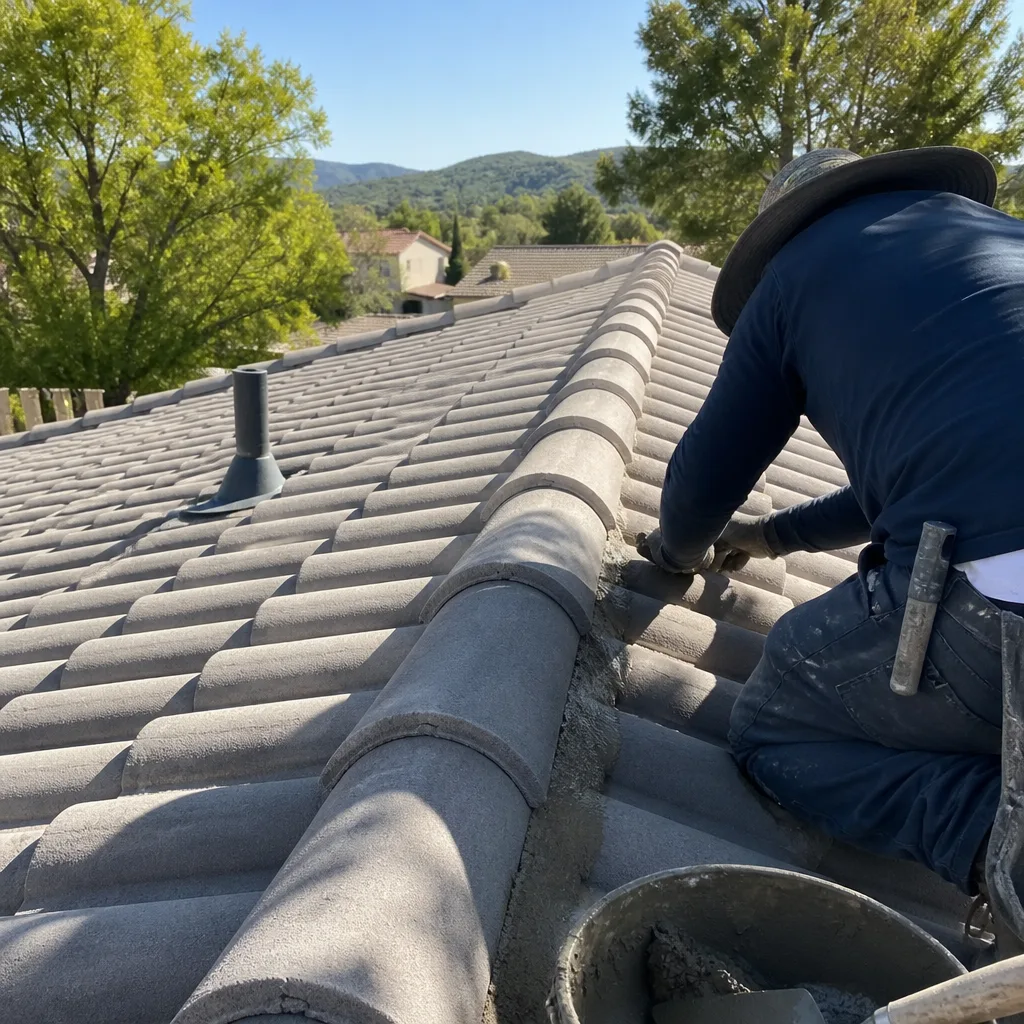
Secondary task: If you have a clay or concrete tile roof, which is common in the North Ranch and Westlake Hills areas, schedule a tile-by-tile walk in June or July. Cracked tiles are the single most common wind entry point. Replacing cracked tiles before October costs $8 to $15 per tile. Waiting until after a Santa Ana cracks adjacent tiles, the repair often quadruples.
What to Inspect After a Wind Event Above 40 mph
In Thousand Oaks, Santa Ana winds routinely hit 40 to 60 mph in the canyons, and gusts over 70 mph occur in the Santa Monica Mountains foothill neighborhoods. After any event sustained above 40 mph, here’s the exact inspection sequence we use on our own service calls. This is designed to be done safely from a ladder or with binoculars from the ground. Do not walk a steep roof without proper safety equipment.
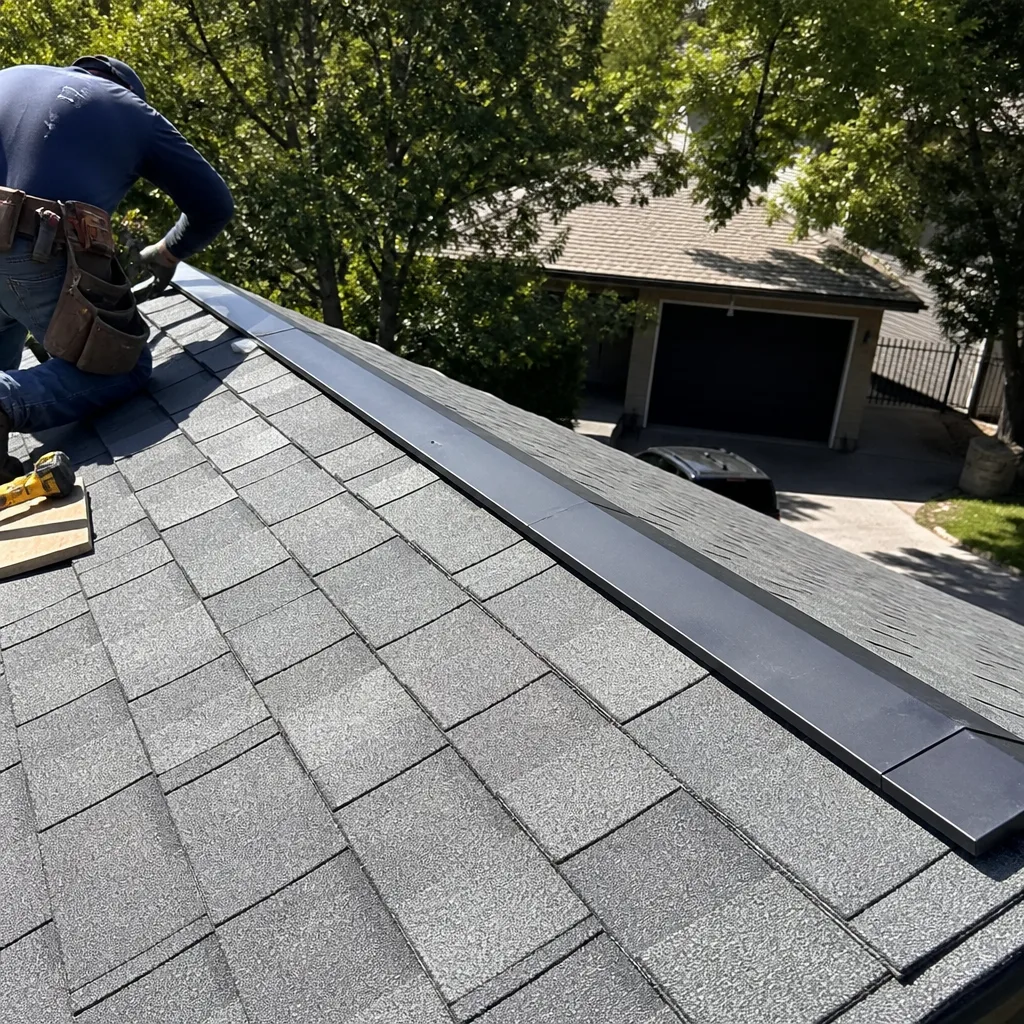
- Ridge caps first. The ridge cap is the row of tiles or shingles that covers the peak where two roof planes meet. Wind hits the ridge first and at the steepest angle. Look for caps that are crooked, lifted at one edge, or shifted sideways by more than a quarter inch. A shifted ridge cap exposes the nails underneath, which rust and fail, which lets the next cap loosen, which starts a chain reaction across the entire ridge.
- Hip tiles next. Hips are the angled edges where two roof planes meet at a corner, and Thousand Oaks homes with tile roofs have hip tiles that are especially vulnerable to Santa Ana uplift. Look for hip tiles that have rotated out of line or sit higher than the surrounding field. Wind gets under the lip of the tile and pries it upward.
- Pipe boot flashings. The rubber boot around your plumbing vent pipe is the most common non-impact failure point in wind events. The wind flexes the rubber until it cracks where it contacts the pipe. Look for visible cracks, splits, or any boot that has ridden up the pipe more than an inch. This is a $150 to $350 repair if caught before rain.
- Edge flashing and drip edge. Walk the perimeter and look at the metal flashing at the roof edges. Wind pulls up drip edge in long sections, especially on asphalt shingle roofs in the Thousand Oaks flatlands area around Thousand Oaks Boulevard. If the metal is bent outward or lifted from the fascia, water will enter behind the gutter.
- Field shingles or tiles near valleys. Valleys are the V-shaped channels where two roof planes meet. Wind funnels through valleys and lifts shingles in these zones first. Look for shingles that are not sitting flat against the next course. On tile roofs, look for tiles in valley areas that are cracked or missing corners.
- Skylight and chimney flashing. After the wind inspection, check the sealant lines around skylights and chimneys. Wind-driven dust and debris sandblasts sealant during a Santa Ana, and hairline cracks that were dormant now become water entry points. Resealing costs $200 to $500. A skylight leak that reaches the interior costs $1,500 to $3,000.
Safety note: ladder work on a two-story Thousand Oaks home, especially on sloped lots in the hills, is genuinely dangerous. Use a spotter, keep the ladder on level ground, and never overreach. If you’re not comfortable with any of these inspections, that’s exactly what professionals are for. A wind inspection call from our Roof Repair in Thousand Oaks team is the most valuable $150 to $250 you’ll spend all season.
California Live Oak and Sycamore Debris: The Granule Loss Problem
Thousand Oaks has one of the most distinctive canopies in Southern California. Coast live oaks, valley oaks, and California sycamores define our neighborhoods, from Wildwood to Oak Park to the older sections around Janss Road. These trees are beautiful. They are also relentless contributors to roof wear in ways most homeowners don’t understand.
The issue is what those leaves become. Live oak leaves are small, stiff, and leathery. When they fall, they don’t blow away easily like maple leaves. They settle into roof valleys, behind chimneys, and against protrusions. Then they break down into a fine, acidic duff that sits directly on shingle surfaces. Sycamore leaves are broad and have a fuzzy underside that grabs granules from asphalt shingles as they skid across the surface during wind.
Here is what accumulated live oak and sycamore debris does to a roof over one season in Thousand Oaks:
- Granule loss acceleration. Oak duff holds moisture against shingle surfaces for weeks after the last rain. Moisture plus tannic acid from the leaves weakens the asphalt bond that holds granules to the shingle mat. We see granule loss on Thousand Oaks roofs with heavy tree cover that occurs three to five years earlier than the same shingle would show on a clear-skies roof.
- Valley damming. Oak leaves pack into valleys and form dams that divert water sideways under shingles. Water that should flow down the valley instead spreads across the roof decking. In the Conejo Valley’s winter rain pattern, a dammed valley on the uphill side of a storm can channel enough water under the shingle course to flood the underlayment.
- Gutter overloading. Sycamore leaves are big enough to clog a 5-inch gutter in one fall drop. Once the gutter is blocked, water overflows onto fascia boards, soffits, and exterior walls. Fascias rot from repeated saturation even when the roof itself is healthy.
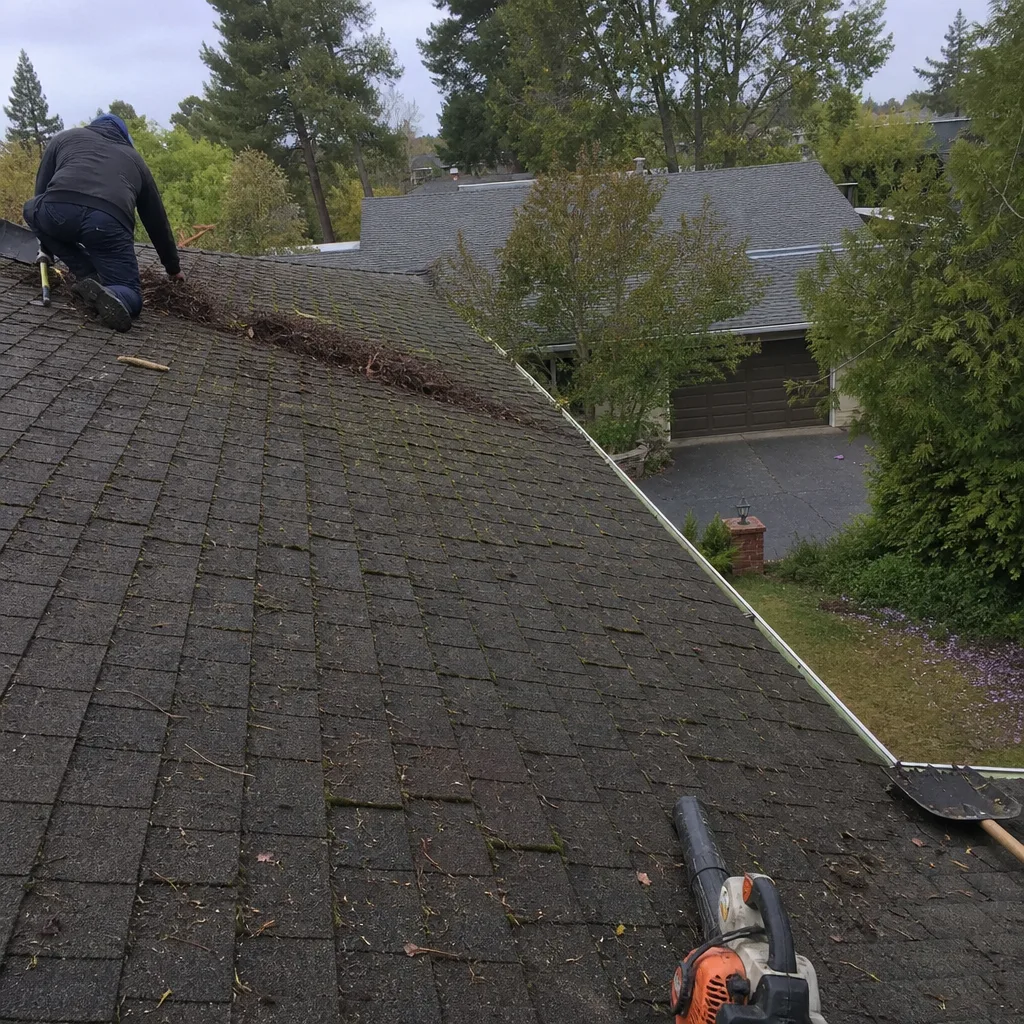
- Moss and lichen growth. Live oak duff plus Thousand Oaks’ marine layer humidity (especially in the south-facing slopes near Lynn Road and Hillcrest Drive) creates moss growth on north-facing roof planes. Moss roots into shingle granules and dislodges them. The damage is permanent: the shingle never regains the lost granule layer.
The fix is quarterly debris removal, not annual. In Thousand Oaks, the natural leaf drop is spread out across a long window from October through February, and live oaks drop intermittently year-round. We recommend a specific quarterly rhythm: September (pre-wind), December (post-leaf-drop), March (post-rain), and June (mid-year dry-season check). For two-story homes where roof access is difficult, a leaf-blower service or gutter cleaning company costs $150 to $300 per visit. The alternative, valley repair and early shingle replacement, costs ten times that.
What You Can Do Yourself vs. What Requires a Contractor
Homeowners in Thousand Oaks ask this question all the time, and the honest answer is that the line is drawn by warranty language and safety physics, not by difficulty. Here’s exactly what you can do without risking your manufacturer’s warranty or your own safety.
Safe for Homeowners
- Gutter and downspout cleaning. From a stable, properly positioned ladder. No roof access required. This is the single highest-value maintenance task you can do yourself.
- Visual inspections from the ground. With binoculars or a phone camera zoomed in, you can see most ridge, hip, and field damage without leaving the ground.
- Debris removal from valleys and behind protrusions. Using a leaf blower from the ladder or an extended-pole rake designed for roofs. Do not stand on a steep or wet roof to do this.
- Photographing the roof. Regular photos from the same positions give you a progressive record of wear. This is free and genuinely useful for warranty claims and resale.
- Attic inspection after rain. Go into the attic during or immediately after heavy rain with a flashlight. Look for water staining on the underside of the decking, wet insulation, or drips. This is the earliest possible leak detection and requires zero roof access.
Requires a Licensed Contractor
- Any sealant or flashing work. Sealant application, flashing replacement, and pipe boot replacement are all warranty-sensitive. GAF and Owens Corning both state in their warranty language that installation work must be performed by a licensed professional to maintain coverage. A homeowner-applied sealant failure that causes decking damage will void the shingle warranty on the affected area.
- Shingle or tile replacement. Replacing a single shingle incorrectly can damage the seal strips on adjacent shingles and create a leak path. Tile work on a Thousand Oaks home with a 4:12 or steeper pitch is genuinely hazardous.
- Any roof walking on a pitch steeper than 6:12. The risk of a fall is not worth any inspection benefit. We use harness systems and roof brackets on steep Thousand Oaks hillside homes, and even then we respect that every ascent carries risk.
- Decking repairs. If an attic inspection shows dark staining or soft spots in the wood, the decking is compromised. Replacing roof decking requires removing the shingles above it, replacing the sheathing, and reinstalling underlayment and shingles. This is structural work.
- Anything involving electrical or solar equipment. If your Thousand Oaks home has solar panels, any work within three feet of the array should involve the solar provider, not a general roof repair. The fire code clearance requirements in Ventura County are specific and enforced.
For the full scope of professional services available, see Roofing Company in Thousand Oaks. If you’re not sure whether something is DIY-safe, call a contractor and ask. The good ones will tell you when a job doesn’t need them.
The Inspection Log: Your Insurance and Resale Record
We recommend every Thousand Oaks homeowner keep a one-page roof inspection log. This isn’t just organizational. It’s evidence. Homeowners insurance claims for roof damage are more successful when the homeowner can demonstrate a pattern of ongoing maintenance. Resale disclosures in California ask specifically about roof condition and maintenance history. And manufacturer warranty claims on brands like Owens Corning and IKO are stronger when you can show dated records of inspections and professional repairs.
Here is the log format we recommend. It’s deliberately simple. It fits on one page per year.
| Date | Event / Trigger | Findings | Action Taken | Contractor / Cost | Photos Taken? |
|---|---|---|---|---|---|
| 9/14/2025 | Pre-Santa Ana inspection | Two loose hip tiles on north side | Scheduled repair | Mercer Roofing / $240 | Yes |
| 11/2/2025 | Post-wind (55 mph gusts) | Pipe boot cracked | Replaced same week | Mercer Roofing / $325 | Yes |
| 12/20/2025 | Post-rain check | No interior stains, attic dry | None | Self-inspection | Yes |
| 3/8/2026 | Professional annual inspection | Granule loss noted on south slope | Monitoring; plan for re-roof in 3-5 yrs | Mercer Roofing / $295 | Yes |
Two notes on how to use this log effectively:
- Photograph everything. Even blurry phone photos timestamp the condition. Five years of photos showing a healthy roof that gradually loses granules tells an insurance adjuster this wasn’t a pre-existing condition.
- Record contractor visits even when the finding is “no action needed.” A dated record that a professional inspected the roof and found it sound is exactly the kind of evidence that helps resale and defends against claim denial.
For installed roofs from Atlas or Tamko shingles, this log is also what you’ll show your warranty provider if a manufacturing defect question arises. The log is free insurance. Keep it.
What Roof Maintenance and Repairs Actually Cost in Thousand Oaks
Homeowners should know what to expect before they call. These are real-dollar ranges specific to the Thousand Oaks market, not national averages. Our Conejo Valley pricing reflects local labor costs, material transport, and the specific roof types common in our area (predominantly tile in the hills, asphalt shingle in the flatlands and newer tract developments).
| Service | Thousand Oaks Price Range | Typical Timeline |
|---|---|---|
| Professional annual roof inspection | $150 – $350 | 1 – 2 hours |
| Gutter cleaning (single-story) | $100 – $200 | Same visit |
| Gutter cleaning (two-story) | $200 – $350 | Same visit |
| Pipe boot replacement | $150 – $350 | 1 – 2 hours |
| Flashing reseal (chimney or skylight) | $200 – $500 | 2 – 4 hours |
| Tile replacement (per tile) | $8 – $15 | Per-tile; most jobs 5 – 15 tiles |
| Shingle repair (small section) | $350 – $800 | Half day |
| Ridge cap re-set (per linear foot) | $6 – $12 | Depends on length |
| Decking replacement (per 4×8 sheet) | $60 – $100 | Adds a day to repair |
| Full post-wind repair (typical) | $500 – $2,000 | 1 – 2 days |
These ranges reflect typical Thousand Oaks conditions: single and two-story homes, tile and asphalt shingle roofs, valley access with reasonable parking, and standard Ventura County permitting when needed. Homes in gated communities like Sherwood Country Club or on steep hillside lots in Lake Sherwood may run toward the upper end due to access restrictions and safety equipment requirements.
What should not cost extra: the written price. We provide a written price before any work starts, always. No surprises on the invoice. That’s a standing policy at Mercer Roofing Co Thousand Oaks home, and it applies to every inspection, repair, and installation we do.
Common Mistakes to Avoid
- Inspecting only after rain, never after wind. In Thousand Oaks, wind creates the entry points and rain exploits them. If you only inspect after storms, you’re always four to six weeks behind the actual damage event. The post-Santa Ana inspection is the one that prevents the post-rain leak.
- Ignoring the trees. Coast live oaks and sycamores are part of the Thousand Oaks identity, but branches touching the roof line are a direct threat during Santa Ana winds. We’ve seen a single sycamore branch break four concrete tiles in one gust. Trim before October, or the wind does the pruning for you.
- Walking on a tile roof without knowing where to step. Concrete and clay tiles crack easily under foot pressure on the wrong point of the tile. The damage you cause by walking it wrong can be more expensive than the inspection you were trying to perform.
- Applying store-bought sealant to flashing. The $12 tube of sealant from the hardware store can void a shingle warranty from Owens Corning or IKO if the application fails and causes decking damage. Flashing and sealant work is a licensed-contractor task. It costs more than $12. It also holds up for more than one season.
- Waiting for a ceiling stain before investigating. By the time water shows on your ceiling in Thousand Oaks, it has traveled through the shingle, underlayment, decking, and insulation. The path it took is now compromised from top to bottom. A ceiling stain is the last symptom, not the first.
- Assuming a new roof doesn’t need maintenance. New roofs fail at the same points old roofs fail: flashing, penetrations, and edges. A five-year-old roof with a cracked pipe boot leaks just like a 25-year-old roof. New roof, same calendar.
- Skipping the written record. If you ever file a roof-related insurance claim in Ventura County, the first thing the adjuster asks for is maintenance history. No log, no photos, no contractor records means a weaker claim. The log takes five minutes per entry.
When to Call a Professional
Call a licensed roofing contractor when you see any of the following: lifted or shifted ridge caps after a wind event, cracked pipe boots, flashing that has separated from the roof surface, interior ceiling stains that grow after rain, soft spots in the attic decking, or more than five cracked tiles in one area. Call before October if you know your roof has existing vulnerabilities, because the Santa Ana season waits for no one. Roof Installation in Thousand Oaks is the more extensive conversation if inspection reveals structural decline; Mercer Roofing Co Thousand Oaks offers free estimates in Thousand Oaks and a written price before any work starts. Call (805) 309-3314 to schedule yours.
Frequently Asked Questions
A professional roof inspection in Thousand Oaks typically costs $150 to $350, depending on roof size, height, and whether attic access is included. Most inspections in the Conejo Valley fall toward the middle of that range for a standard two-story home. Call (805) 309-3314 for an exact quote; our written price is provided before the inspection is scheduled, not after.
Lifted ridge caps and cracked pipe boot flashings are the two most common post-Santa Ana issues we repair. The wind flexes the rubber pipe boot until it cracks, and it catches the lip of ridge caps and pries them upward. Both are inexpensive to fix if caught before rain, and both cause significant interior damage if ignored.
Yes, and it’s equally important. Tile roofs collect oak and sycamore debris in valleys and behind protrusions just like shingle roofs. The debris holds moisture against the underlayment below the tiles, which degrades the underlayment over time. Tile underlayment replacement costs $3 to $6 per square foot, so debris removal is very inexpensive protection.
Basic maintenance like gutter cleaning and visual inspection will not void your warranty. However, most shingle manufacturers, including GAF and Owens Corning, require that repair work be performed by a licensed professional to maintain warranty coverage on affected areas. Sealant and flashing work done by a homeowner that later fails and causes decking damage will typically void the shingle warranty at that point. Check your specific warranty document, and when in doubt, call a licensed contractor familiar with Roofing Permits, Codes & Inspections in CA: What You Need to Know.
We recommend a professional inspection annually in March, after the rain season ends, plus a focused wind-damage inspection after any Santa Ana event above 40 mph. The March inspection is the comprehensive one. The post-wind inspection is quicker and focused on specific wind-vulnerable points.
Mercer Roofing’s 365-Day Done Right Promise means if the work is not right within a year, we make it right. Every repair includes a written guarantee, and if a repair fails within that year, a second visit is free. The written price is provided before any work starts. Call (805) 309-3314 for details on what the guarantee covers for your specific repair scope.
The Bottom Line
The roof over your Thousand Oaks home is dealing with a specific, predictable set of threats. Santa Ana winds in October and November. Winter rain from December through March. Coastal live oaks and sycamores dropping debris across all of it. The maintenance checklist that works is the one that matches that calendar. Inspect after every wind event above 40 mph. Clean debris quarterly. Inspect flashing before December rain. Do a full professional inspection in March. Keep a written log. That sequence, repeated every year, is what stands between a $300 repair and a $2,400 one. When you’re ready for a professional inspection or repair, we’re the ones who show up with a photo ID badge, a written price, and a name you already know.
Written by Grant Whitlock, Owner at Mercer Roofing Co Thousand Oaks, serving Thousand Oaks since 2000.
Ready to schedule your roof inspection? Call (805) 309-3314 for a free estimate. A live person answers, 24/7.
See the difference
 Before
 After
After Before
 After
After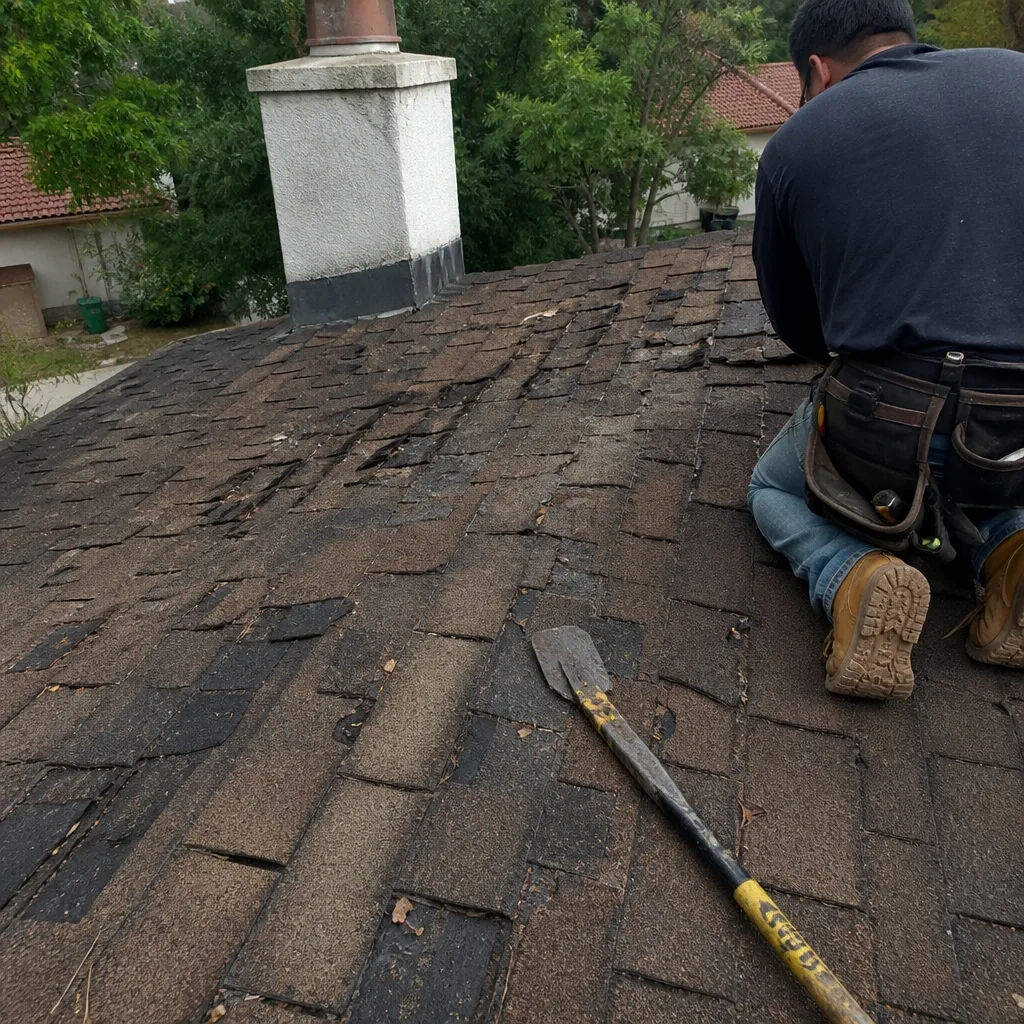 Before
 After
After