
Last updated October 17, 2026
 Metal roofing
 Architectural shingles
 Tile roofing
 GAF
GAF Flat & low-slope
Free roof inspection with deck photos before we talk money - GAF and Owens Corning certified installation
Roofing Warning Signs: A Thousand Oaks Homeowner’s Reference Guide
Most Thousand Oaks roofing guides tell you to grab a flashlight and crawl into the attic. That’s fine advice, but here’s what we’ve learned after years of inspecting roofs across this valley: the earliest warning signs are almost always visible from your driveway or sidewalk, not your attic. The granule pile you’ll find at the base of your downspout after the first real rain of November isn’t just debris, it’s evidence your asphalt shingles have been quietly degrading through the summer heat. This reference guide to roofing in Thousand Oaks is built around the moments you should actually be looking: after a Santa Ana, after a heavy rain, and during the brutal August stretch. Organized by trigger, not symptom, because that’s how Thousand Oaks homeowners actually catch problems early.
Quick Answer
The most common roofing warning signs for Thousand Oaks homeowners are granule accumulation in gutters and downspouts after rain, displaced hip tiles or lifted ridge caps after Santa Ana winds, and ceiling stains that grow or darken within 48 hours of rainfall. A single granule loss observation or one curled shingle is rarely urgent, but any water stain near an electrical fixture, HVAC unit, or load-bearing beam should prompt a call the same day. If you’re not sure what you’re looking at, roof repair in Thousand Oaks starts with a written estimate, so you’ll know the cost before any work is approved.
Styles & brands we work with
Table of Contents
- After a Santa Ana: What Wind Damage Looks Like From the Ground
- After Rain: Reading Ceiling Stains and Tracing Leaks
- Summer Heat: Granule Loss, Pipe Boots, and Blistering
- Call Today vs. Schedule It: A Decision Framework
- Warning Signs Contractors Overstate (And the Language That Should Make You Pause)
- Tile vs. Shingle Roofs in Thousand Oaks: Different Materials, Different Warnings
- The Quiet Season: What to Check Every January and July
- What a Homeowner Can Check Safely (And What Needs a Pro)
After a Santa Ana: What Wind Damage Looks Like From the Ground
Santa Ana winds hit Thousand Oaks with gusts that routinely exceed 50 mph in the foothill neighborhoods like Lynn Ranch, Sunset Hills, and the canyons north of the 101. Those winds don’t just rattle patio furniture, they lift tiles, peel flashing, and stress ridge caps in ways that are visible from ground level if you know what to look for. After any significant Santa Ana event, walk the perimeter of your home once, as outlined in our seasonal roofing care guide for Thousand Oaks.
Hip tiles and ridge caps
On the clay and concrete tile roofs that cover a large share of Thousand Oaks homes, the most common wind damage is a displaced hip tile or a lifted ridge cap. From the ground, a lifted ridge cap looks like a dark line where the cap should sit flush against the tile below it. A displaced hip tile will appear crooked or raised at one corner. These are not cosmetic problems. A lifted ridge cap exposes the fasteners and underlayment beneath, and the next wind event can turn a small lift into a full tear-off that sends tile flying. In neighborhoods like Wildwood and Newbury Park, where homes sit on exposed ridgelines, we see this pattern repeatedly after every wind season.
Flashing stress at valleys and penetrations
Look at the metal flashing around chimneys, skylights, and the valleys where two roof planes meet. After high winds, flashing can pull away from the roof surface by as little as a quarter inch, which won’t be visible from the ground, but the wind also scatters debris, so check for bent flashing, which often shows as a glint of metal at an odd angle. Bent flashing compromises the seal at the most leak-prone points of any roof. In Thousand Oaks, the combination of wind-driven rain and stressed flashing is the most common cause of the leaks we repair in January and February, plus debris accumulation at valley channels, which forces water sideways under shingles or tiles.
Numbered ground-level inspection steps after a wind event
- Stand at the street and look at the roof’s silhouette. A healthy roofline is a continuous line. Gaps, bumps, or irregular shadows indicate displacement.
- Walk to each corner of the home and check hip tiles and ridge caps. Look specifically for dark lines or uneven spacing.
- Inspect the ground around the home for tile fragments, shingle tabs, or pieces of flashing. These are direct evidence of wind lift.
- Check gutters for wind-blown debris. Heavy debris accumulation in valleys after a wind event can redirect water under the roofing material.
- If you see anything displaced, take a photo from the ground. Do not climb. Mercer Roofing Co Thousand Oaks can assess wind damage with a written repair estimate before anything is touched.
After Rain: Reading Ceiling Stains and Tracing Leaks
Thousand Oaks gets most of its rainfall between December and March, and that’s when leak evidence shows up inside the home. The first thing to understand is that not every ceiling stain is an active leak. Many are old stains that reactivate visually when indoor humidity spikes during a rainy week. The stain darkens because the mineral deposits left behind are hygroscopic, it absorbs moisture from the air, not because water is actively entering.
How to distinguish active leaks from old stains
An active leak changes within 24 to 48 hours of rainfall. It grows, darkens at the edges, or develops a new visible wet spot. An old stain reactivated by humidity will look darker overall but won’t grow and won’t feel wet to the touch. Mark the stain’s perimeter lightly with a pencil and check it again the next morning. If the stain has moved past your mark, water is entering the home. This one test saves homeowners real money, because we’ve seen entire roof replacements sold on the back of stains that were years old and completely dry. When a leak is active, the ceiling stain’s shape tells you something about the water’s path. A round stain directly under a pipe boot or at the base of a valley suggests a penetration leak or valley overflow. A long, thin stain running along a ceiling joist suggests water is traveling laterally from a distant entry point, often at a roof edge or gutter line. Water follows gravity and the path of least resistance, which is rarely a straight line down.
What to check after the first heavy rain of the season
- Ceiling stains near chimneys, skylights, and bathroom exhaust vents. These penetrations account for a disproportionate share of Thousand Oaks leak calls, especially on homes built in the 1960s through 1980s, which make up a significant portion of the Thousand Oaks housing stock.
- Damp spots in the upper corners of exterior walls. These often indicate water wicking under the roof edge, not a leak in the field of the roof.
- Granule accumulation in gutters and downspouts. See the summer section below for why this matters, but the first heavy rain of fall is when accumulated granules wash down all at once, making the loss visible.
- A musty smell in the attic or in rooms directly below the roofline. Active moisture in attic insulation produces an odor that’s distinct from general house smells.
Summer Heat: Granule Loss, Pipe Boots, and Blistering
Thousand Oaks summer temperatures routinely sit in the 90s for days at a time, and your roof’s surface temperature can run 40 to 60 degrees hotter than the air. That heat does something specific to asphalt shingles, it accelerates granule loss. Granules are the mineral coating fused to the shingle’s asphalt layer; they reflect UV and shield the asphalt from direct sun. When they come off, the asphalt is exposed and begins to oxidize and crack. A shingle roof that loses significant granules over a single summer is a roof that has silently lost two to four years of service life, which brings us back to the downspout observation from the top of this guide.
How to assess granule loss without climbing
After the first heavy rain of fall, check the area where your downspouts meet the ground or drain into a catch basin. If you see a visible accumulation of dark, sand-like material, that’s granule shed. A modest amount is normal. A pile the size of a saucer or larger at a single downspout, especially when paired with visible bald spots or shiny areas on the shingles themselves, indicates accelerated wear. From ground level on a sunny day, look at the roof face. Healthy asphalt shingles have a uniform matte texture. Bald shingles look shiny where the sun catches exposed asphalt.
Pipe boots and flashing under heat stress
The rubber boot that seals the plumbing vent pipe to your roof is one of the most failure-prone components we replace on Thousand Oaks homes, not because rubber is weak, but because heat and UV dry it out over time. Cracking at the pipe boot base shows up as fine lines or chips visible from the roof surface, but the warning sign from below is a water stain on the ceiling directly beneath a bathroom or plumbing wall. These stains often appear during summer storms, but the damage started months earlier under heat stress. If you can see the pipe boot from a second-story window or an adjacent hillside, look for obvious cracking or a boot that has pulled away from the pipe.
Blistering on flat and low-slope sections
Many Thousand Oaks homes, especially those in Conejo Valley neighborhoods with additions from the 1970s and 1980s, have flat or low-slope sections over covered patios, garage extensions, or bonus rooms. These sections are often built with modified bitumen or rolled roofing, which blisters under sustained heat. From the ground or a patio, blisters look like raised bubbles or bumps in the roof surface. Small blisters are not an immediate failure point, but once blisters form, the surface is compromised and the clock is running. If a blister pops and exposes the felt or fabric beneath, water will enter the home during the next rain, and these low-slope sections are among the most expensive leaks to repair because they rarely dry out on their own.
Call Today vs. Schedule It: A Decision Framework
We want Thousand Oaks homeowners to feel confident making one simple decision, as covered in our DIY vs professional roofing guide: is this a call-today situation or a schedule-it situation? The dividing line is water, specifically whether water is near electricity, structural framing, or insulation.
Call today if you see any of these
- Water staining within three feet of an electrical fixture, ceiling-mounted light, fan, or outlet.
- A ceiling stain that is actively dripping or that has grown since the last time you checked.
- Water staining on a ceiling beam, around a ceiling joist, or anywhere near a load-bearing wall. Wet framing loses strength, and the repair bill grows the longer it sits.
- Visible daylight through the roof deck in the attic. This means an actual penetration exists, not just a slow leak.
- Any water stain that appears directly below a flat or low-slope roof section. These sections hold water and don’t dry, and the damage compounds unusually fast.
Schedule at your convenience for these
- Granule accumulation that is not paired with visible bald spots or interior stains.
- Minor curling at shingle edges visible from the ground, without associated leaks.
- A small, isolated area of moss or algae growth, provided there’s no evidence of water entry.
- Flashing that looks weathered but remains in place with no visible displacement.
- A single displaced hip tile or lifted ridge cap that you’ve photographed and that isn’t over a bedroom or living space.
When the situation calls for a repair, it starts with a written price. Mercer Roofing’s repair process in Thousand Oaks always includes a written estimate before work begins, a written guarantee on the repair, and a free second visit if that repair fails within 365 days. You’ll know the cost before you commit, and you’ll have the guarantee in writing.
Warning Signs Contractors Overstate (And the Language That Should Make You Pause)
Most roofing contractors are honest, but the incentive structure of this industry is hard to ignore: a repair invoice is worth hundreds to a few thousand dollars, while a full replacement is worth fifteen to thirty thousand or more. We think Thousand Oaks homeowners should know the specific phrases that signal pressure more than diagnosis, so they can protect themselves with a second opinion.
Phrases that warrant a second opinion before any commitment
- “Imminent collapse.” Flat or low-slope roofs can fail catastrophically after prolonged water damage, but on a typical pitched Thousand Oaks roof, imminent collapse from routine wear is almost unheard of. If the decking were truly in danger of collapsing, the ceiling would be visibly bowed and sagging, and a structural engineer, not a salesperson, is the right call.
- “The entire roof must be replaced.” Sometimes true. Often the next sentence should be “which sections, and why?” A roof over a bedroom might need replacement while a newer addition over the garage is fine. Demand specificity.
- “Your tiles are too dangerous to walk on, so we can’t repair.” Tile roofs require different repair techniques, not blanket replacement. Skilled tile roofers in Thousand Oaks work around tile fragility and replace only what’s damaged.
- “Your shingles are at end of life, and we can’t warranty repairs on an older roof.” A repair on an older roof carries a shorter realistic lifespan, but a targeted repair is often a perfectly good financial decision, especially if the homeowner plans to sell within a few years. At Mercer Roofing, every repair includes a 365-day written guarantee, period, regardless of the roof’s age.
- “Granule loss means your roof is failing.” Some granule loss is normal for any asphalt shingle roof, especially after heat waves. Accelerated loss on a roof that’s 15 or more years old is a flag, not a failure. Have a contractor assess the specific areas and show you photos.
We’ve written this section carefully because the right response to a high-pressure warning is not to ignore it but to verify it. A second opinion costs an hour of your time and it’s often free if the inspection includes a written estimate. The wrong response is signing a replacement contract under duress because a door-to-door crew told you the sky is falling.
Tile vs. Shingle Roofs in Thousand Oaks: Different Materials, Different Warnings
Thousand Oaks is a tile town in a way that most cities are not. The clay and concrete tile profile that covers homes from the Conejo Valley floor to the Lang Ranch foothills is part of the architectural character of the city, and tile roofs behave differently than asphalt shingle roofs. Understanding which material you have changes what you watch for.
Clay and concrete tile roofs
Tile roofs last longer than shingles, typically 40 to 50 years for the tile itself, but the underlayment beneath the tile has a shorter lifespan, usually 20 to 30 years, and that’s where tile roof failures actually occur. The warning signs for tile in Thousand Oaks are displaced or cracked tiles after wind events, visible underlayment at tile gaps, which appears as a dark fabric or paper-like material showing between tiles, and water intrusion during heavy rain despite no visible tile damage. That last one is a textbook underlayment failure. The tiles look fine, but water is getting through and finding the compromised layer beneath. We also see a specific pattern on homes with original 1980s tile roofs: the mortar or fasteners at the ridge caps become brittle over decades of heat and Santa Ana cycles, and one strong wind event pops them loose. If you see dark gaps at the ridge line, that’s your underlayment exposed and the clock is running.
Asphalt shingle roofs
Asphalt shingles are the budget-friendlier option that covers much of the newer construction in Thousand Oaks, including townhomes and planned communities. The manufacturers we work with most often, GAF, CertainTeed, and Owens Corning, engineer modern shingles to resist UV and wind better than their predecessors, but the failure signs remain the same: granule loss, curling at the edges, and cracking across the shingle face. The hot-dry cycle in Thousand Oaks accelerates two of those three. Curling is a product of repeated thermal expansion and contraction. Cracking is oxidation. If you see both accumulating on a roof that’s over 15 years old, you’re looking at a roof in the final quarter of its service life, and replacement planning should start. A roof installation in Thousand Oaks is a significant investment, so we always recommend starting the conversation with a written estimate and a clear explanation of the material options before any decisions are made.
The Quiet Season: What to Check Every January and July
The worst time to discover a roofing problem is during the February storm that’s currently dumping water into your attic. The best time is during the quiet season, when the weather is mild and repair crews are scheduling faster. Thousand Oaks has two natural inspection windows: January, after the wind season has done its damage but before the heaviest rain, and July, after the early summer heat has stressed the materials but before the August peak.
January checklist
- Walk the ground-level perimeter after the first Santa Ana events and check for displaced hip tiles, lifted ridge caps, and tile or shingle debris on the ground.
- Check gutters and downspouts after the first substantial rain and note granule accumulation.
- Inspect ceiling stains on the first dry day after a rain and mark any that appear active.
- Scan the roof from the street for anything that looks irregular in silhouette or color.
July checklist
- Check for visible cracking at pipe boot bases if those penetrations are visible from a window or hillside.
- Look for fresh blistering on flat or low-slope sections over patios and additions.
- Note any areas of the roof where granules appear thin or the shingle surface looks shiny.
- Check the attic on a hot afternoon. If the attic is excessively hot, above 130 degrees, ventilation may be insufficient, which shortens shingle life. This is a longer-term issue, not an emergency.
What a Homeowner Can Check Safely (And What Needs a Pro)
We want to be direct about this: you do not need to climb on your roof to inspect it well. In fact, we recommend you don’t. Hip tiles and ridge caps can be unstable after wind events, and a fall from a second-story roofline is a serious injury waiting to happen. The ground-level and interior checks in this guide cover the overwhelming majority of early warning signs. Here’s where the line is.
Safe to check yourself
- Ground-level visual inspections after wind and rain events.
- Gutter and downspout inspections for granule accumulation and debris.
- Interior ceiling stain monitoring with the pencil-mark method.
- Attic checks for daylight penetration, damp insulation, and visible decking damage, provided the attic has proper flooring and adequate light.
Leave to a professional
- Any roof walking or ladder access to inspect tiles, shingles, or flashing up close.
- Flashing repairs, re-securing of ridge caps, and any work requiring the removal or re-setting of tiles.
- Any electrical wiring assessment related to water intrusion.
- Assessment of whether a cracked tile or lifted cap has compromised the underlayment beneath.
When you need a professional assessment, the process should be predictable. Mercer Roofing’s Threshold Verified standard means every technician who comes to your Thousand Oaks home has been background-checked and identity-verified before they ever knock. Their name and photo are sent to you ahead of the visit, and they’ll present a photo ID badge at the door. You’ll know exactly who is on your property, which matters whether you’re home alone, managing young kids, or simply prefer not to open the door to an unverified stranger. Every visit starts with a written price before any work begins, and every repair is covered by a written 365-day guarantee.
Common Mistakes to Avoid
- Assuming a dry ceiling stain is no longer a problem. A stain from an old leak doesn’t disappear, but the leak that caused it might be intermittent. Mark the stain and check after the next heavy rain. If it grows, it’s active, regardless of how dry it looked in July.
- Ignoring granule accumulation because “the roof looks fine from the street.” The downspout is often the first place total granule loss becomes visible. By the time the roof face looks obviously bald, you’ve lost more service life than you think.
- Skipping post-Santa Ana inspections because there’s no visible damage from the front walk. Wind hits different roof faces differently depending on the home’s orientation. Walk all four sides, or at least the sides facing the prevailing wind, which in Thousand Oaks typically comes from the northeast during Santa Ana events.
- Dismissing lifted ridge caps as “just one tile.” A lifted ridge cap exposes the underlayment and the fastening points. The next wind event can tear off more than the one tile you saw.
- Assuming tile roofs don’t leak if the tiles are intact. The underlayment is the waterproof layer, not the tile. If the underlayment is compromised, water gets in even with every tile in place. This is the most misunderstood fact about tile roofs in Thousand Oaks.
- Calling for a full replacement before having a repair assessment. Some roof conditions genuinely require full replacement. Many do not. A written repair estimate gives you a baseline to evaluate a replacement pitch against.
- Climbing onto the roof to “get a better look.” A fall from a Thousand Oaks roofline, especially on a two-story home in the foothill neighborhoods, can be catastrophic. Ground-level inspection plus a professional assessment is the safe path.
See the difference
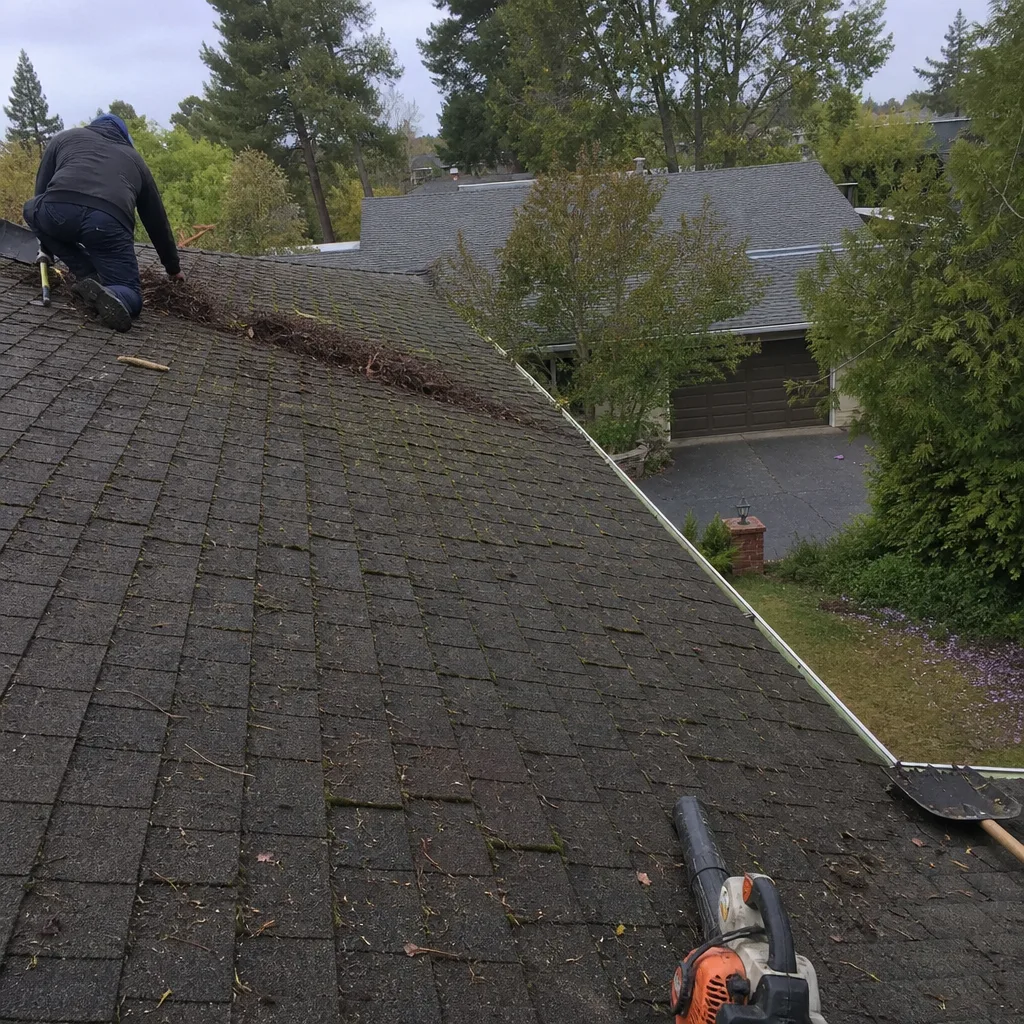 Before
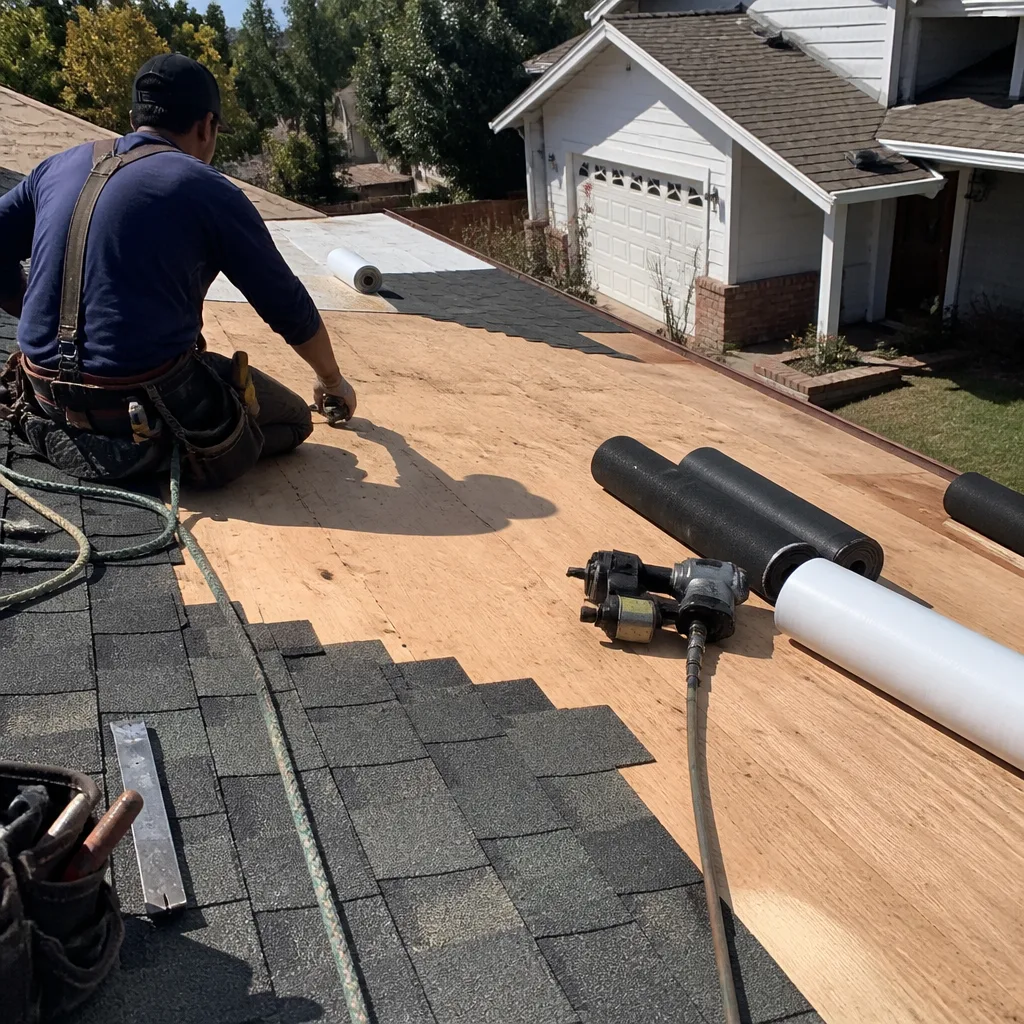 After
After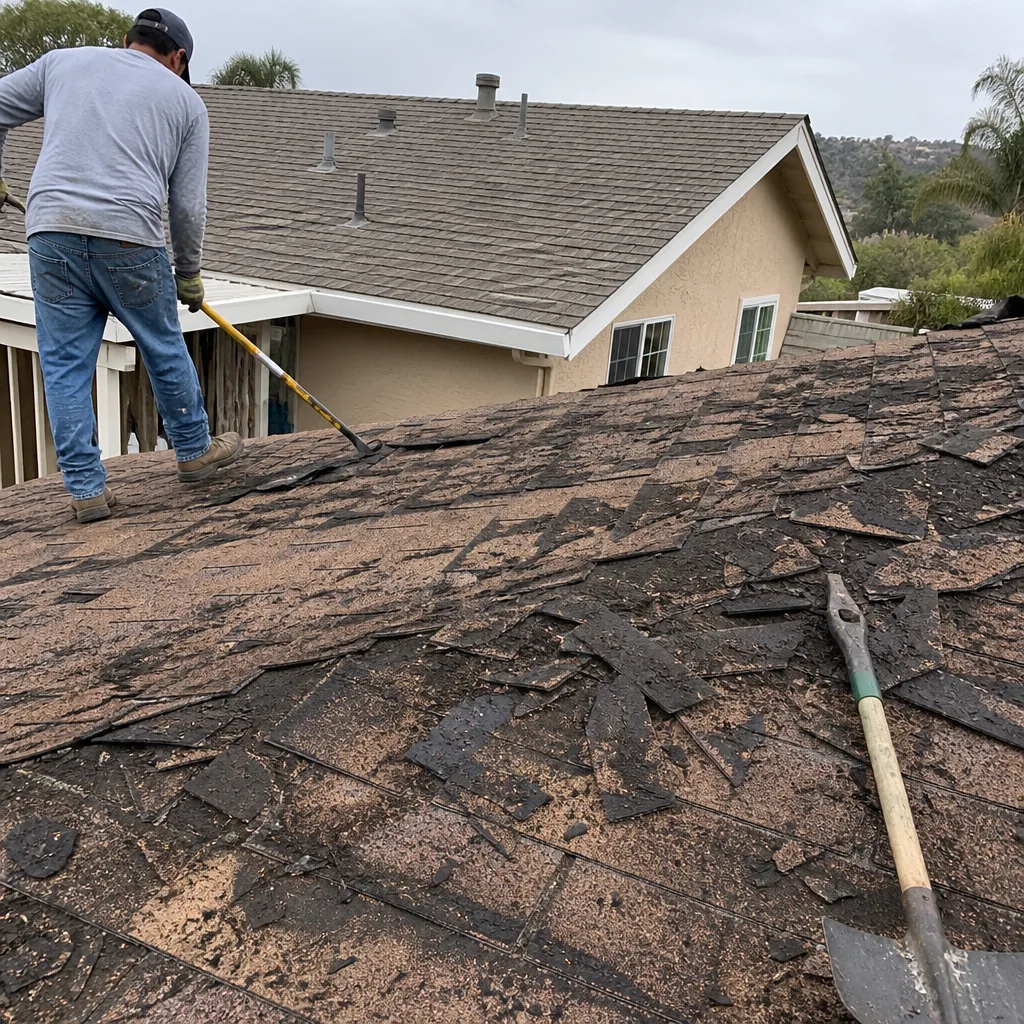 Before
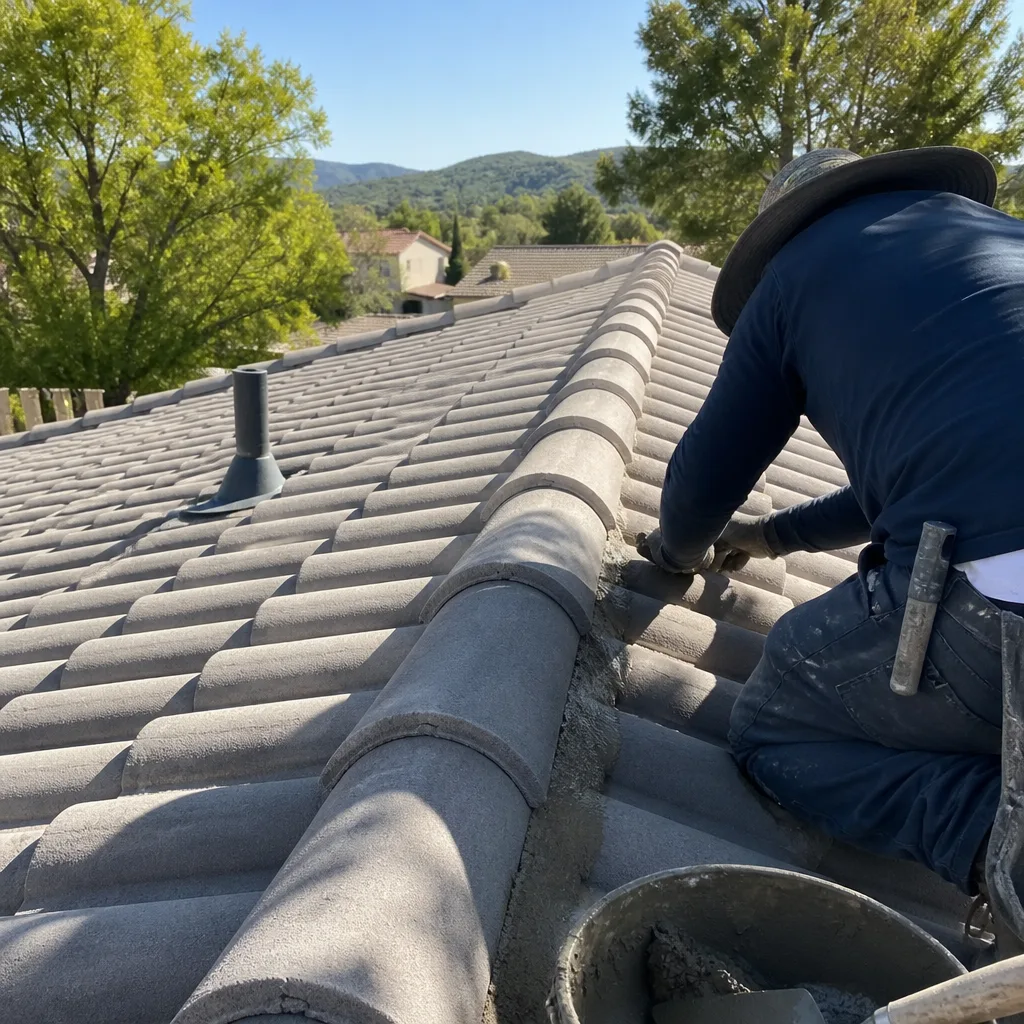 After
After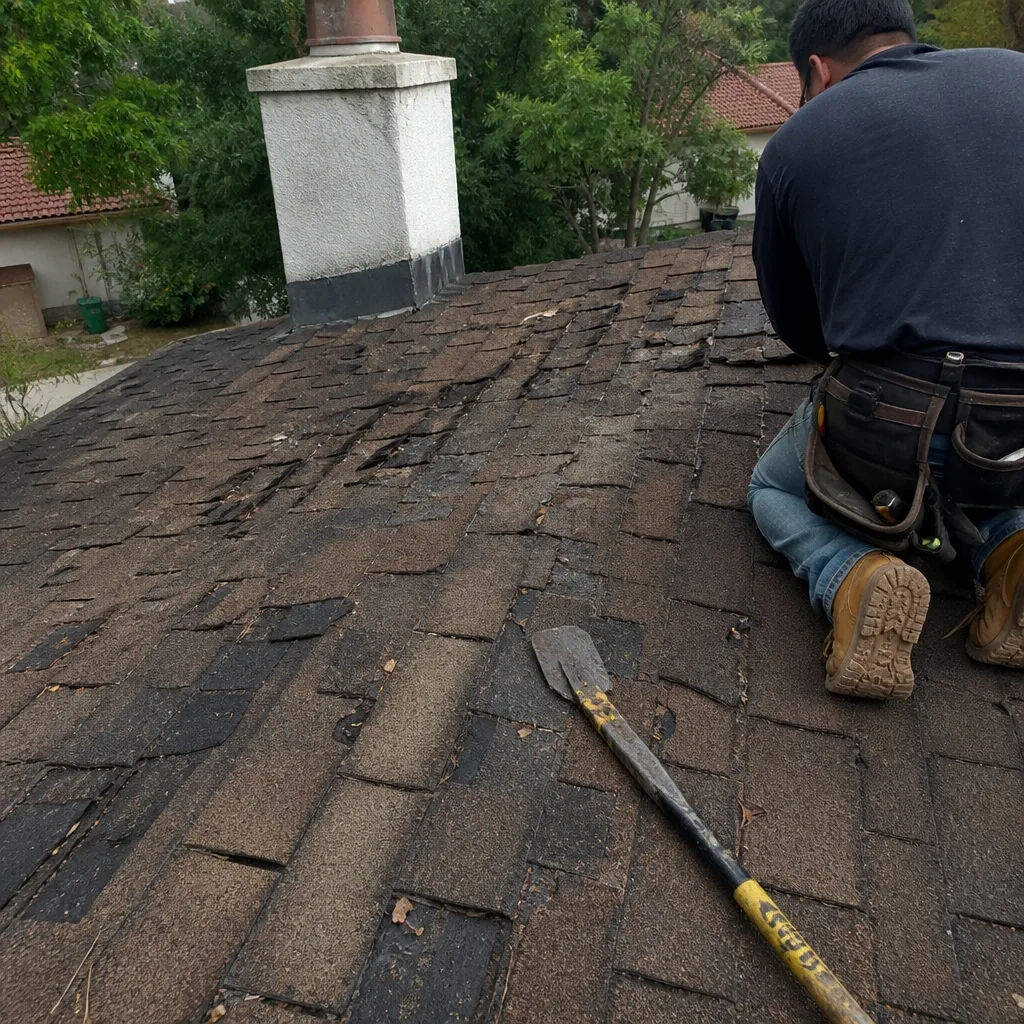 Before
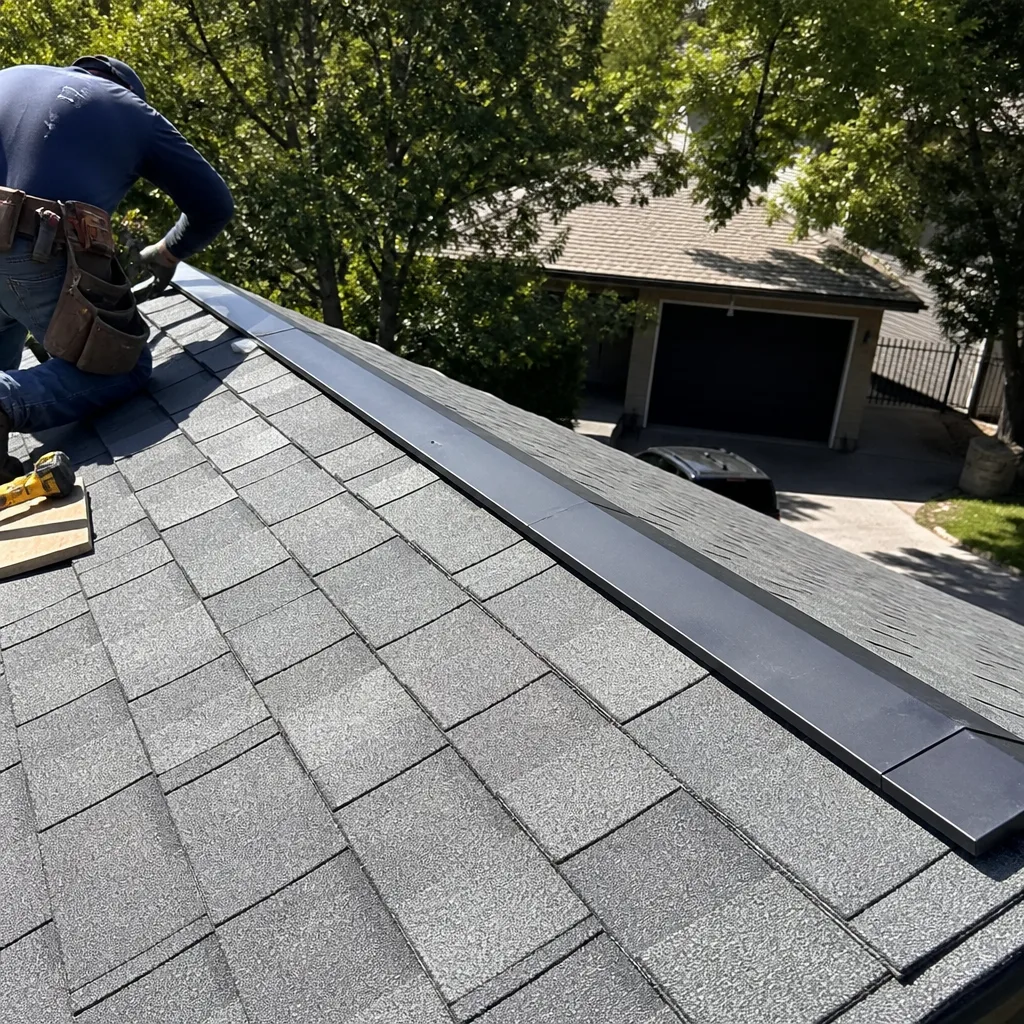 After
AfterWhen to Call a Professional
Call a professional when you’ve confirmed an active leak, when you’ve spotted displaced tiles or lifted ridge caps after a wind event, when granule loss is paired with visible bald spots or interior stains, or when any water staining appears near electrical fixtures or structural framing. Call if you’ve found blisters on a flat roof section that have opened or appear fragile. Call if your roof is over 15 years old and you’re seeing multiple warning signs simultaneously, curling shingles, granule accumulation, and interior stains. That combination means the roof is failing in more than one way. Mercer Roofing Co Thousand Oaks offers free estimates throughout Thousand Oaks and the surrounding Conejo Valley, and every estimate includes a written price before any work starts. Call (805) 309-3314 to schedule yours.
Frequently Asked Questions
Walk the perimeter and look for displaced hip tiles, lifted ridge caps, tile or shingle debris on the ground, and bent flashing around penetrations. Check the interior for ceiling stains that grow within 48 hours of rainfall. If you see any of these, call (805) 309-3314 for a professional assessment with a written estimate. Most storm damage in Thousand Oaks is visible from the ground.
Granule loss is the mineral coating separating from your asphalt shingles, a natural process that heat accelerates. A small amount after the first fall rain is normal. A visible pile at a single downspout, especially paired with shiny or bald spots on the roof, means the shingles have lost two to four years of service life and are degrading faster than they should. Call (805) 309-3314 for an exact assessment, the estimate is free.
Minor repairs like re-securing a displaced hip tile or patching flashing typically run $300 to $800 in Thousand Oaks. Pipe boot replacement typically falls between $350 and $650. Larger repairs involving multiple tiles or valley work can run from $800 to $2,500. Full section repairs on low-slope areas push higher. The only way to know is a written estimate, which Mercer Roofing provides before any work begins. Call (805) 309-3314 for an exact quote.
The answer depends on the roof’s age, the extent of the damage, and whether multiple failure points are present. Damage confined to one flashing point, one pipe boot, or a few tiles is usually repairable. Widespread granule loss, curling across large sections, or repeated leaks in different locations point toward replacement. If a contractor tells you replacement is required, ask for specifics and a written repair estimate for comparison. Call (805) 309-3314 for a free assessment and written price in Thousand Oaks.
An active leak stain grows or darkens at the edges within 24 to 48 hours after rainfall and may feel damp to the touch. Mark the stain’s perimeter with a pencil, then check again the next morning. If it has moved past your mark, water is entering the home. Stains near electrical fixtures or structural framing need same-day attention. Call (805) 309-3314 to schedule an inspection with a written estimate.
Most minor repairs do not require a permit in Thousand Oaks, but re-roofing projects typically do. The city requires permits for roof replacements to ensure the work meets current code. Any contractor you work with should handle the permitting process and be willing to put the permit status in writing. Mercer Roofing pulls permits where required and provides written documentation for every repair and installation. Call (805) 309-3314 with questions about your specific project.
The Bottom Line
Thousand Oaks roofing problems announce themselves early, but only if you’re looking at the right moments. After every Santa Ana, check your ridge caps and hip tiles. After every heavy rain, mark your ceiling stains and check for growth. During the summer, watch your downspouts for granule accumulation and your flat roof sections for blisters. The difference between a $400 repair and a $25,000 replacement is often just a few months of attention. When you need help, call (805) 309-3314, get a written estimate, and know exactly who’s coming to your door before they arrive. For more guides & resources, visit our blog. That’s how we’ve operated in Thousand Oaks since 2000, and it’s how we’ll keep operating.
Written by Grant Whitlock, Owner at Mercer Roofing Co Thousand Oaks, serving Thousand Oaks since 2000.